systemd in Production
Service Management, Boot, Observability, and Image-Based Systems.
Coming soon
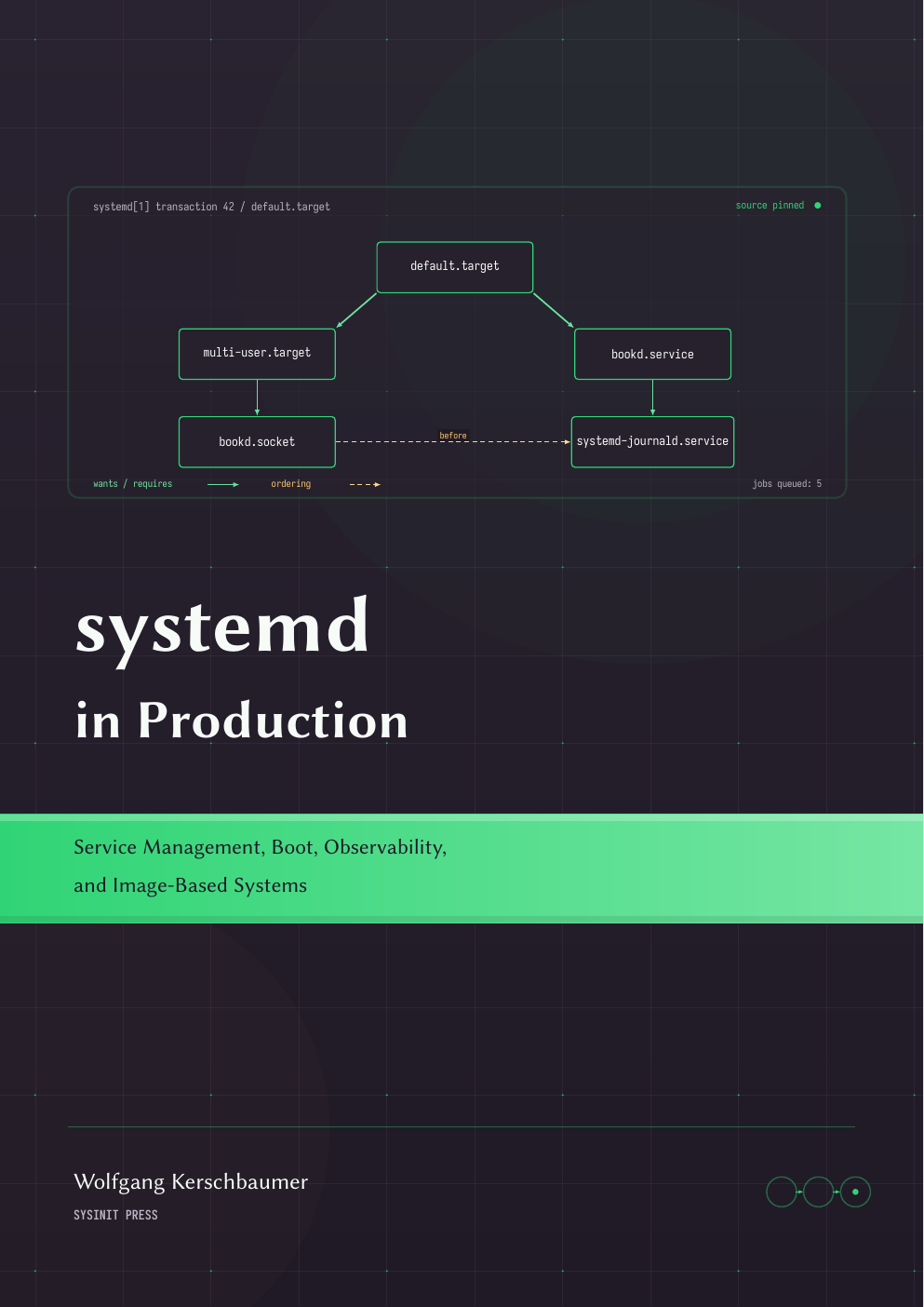
The book starts with a single service request. It traces where the unit comes from, how systemd schedules the job, when the cgroup exists, how the process reports readiness, and what the journal records. Later chapters use the same model for boot and storage, network services, containers, and image updates. Implementation-sensitive claims cite a pinned upstream source tree. A small reference daemon returns in the service chapters and the final deployment.
Status: all 26 chapters and 5 appendices are drafted and fact-checked (about 130,000 words). Runtime verification remains, and external publication is not configured yet.
First edition ships DRM-free as PDF and EPUB, with free updates.
Reader poll Readers pick which Sysinit Press title we finish next. systemd in Production is on the ballot.
Vote for this bookHow systemd manages a service and a system.
The first four parts explain unit loading, service execution, resource control, and the journal. The remaining chapters follow the boot process and cover devices, storage, networking, containers, and image updates. Open a part to see its chapters.
What this book assumes, and how to read it
Part 1 Foundations 4 chapters
- 1 Why systemd
- 2 Inside the Managers
- 3 Unit Files
- 4 Dependencies and Transactions
Part 2 Service Lifecycle and Activation 6 chapters
- 5 Service Types and Readiness
- 6 Execution Context
- 7 Failure and Recovery
- 8 Socket Activation
- 9 Timers, Paths, Devices, and Automounts
- 10 Transient Units and Control APIs
Part 3 Resources, Isolation, and Identity 4 chapters
- 11 Cgroups, Slices, and Scopes
- 12 Service Sandboxing and Hardening
- 13 Credentials and Secrets
- 14 User Managers, Sessions, and Identity
Part 4 Observability and Reliability 4 chapters
- 15 The Journal
- 16 Diagnosing Units and Boot
- 17 Failure Evidence and Memory Pressure
- 18 A Production Service
Part 5 Boot, Devices, and Storage 4 chapters
- 19 Boot and Shutdown
- 20 udev and Device Management
- 21 Mounts and Storage Assembly
- 22 systemd-boot, UKIs, Secure Boot, and TPM2
Part 6 Networked and Image-Based Systems 4 chapters
- 23 systemd-networkd
- 24 Name Resolution, Time, and Host Configuration
- 25 Containers, VMs, and Extension Images
- 26 Image Lifecycle and Atomic Updates
Part 7 Appendices 5 appendices
- A Migration from SysV, cron, and supervisor
- B Troubleshooting Field Guide
- C Unit Directives, Load Paths, and Public APIs
- D Sources, Reproducibility, and Verification Baselines
- E Glossary and Generated Subject Index
For engineers who operate services on Linux.
This book is for Linux administrators, SREs, platform engineers, security engineers, and distribution engineers. You should be comfortable with the shell and with ordinary processes, files, and networking. You do not need to have read systemd source or memorized its directive catalog.
- Engineers who run systemd-managed services and want to predict what the manager will do, and why.
- Teams adopting sandboxing, cgroup resource control, TPM2-backed credentials, and socket or timer activation.
- Builders of image-based Linux systems: systemd-boot, UKIs, sysext, and atomic updates with repart and sysupdate.
Coming soon.
Join the shared Sysinit Press book list for release news, sample chapters, and updates to published editions. The first edition will include DRM-free PDF and EPUB files with free updates.
The signup uses double opt-in. Every message includes an unsubscribe link.